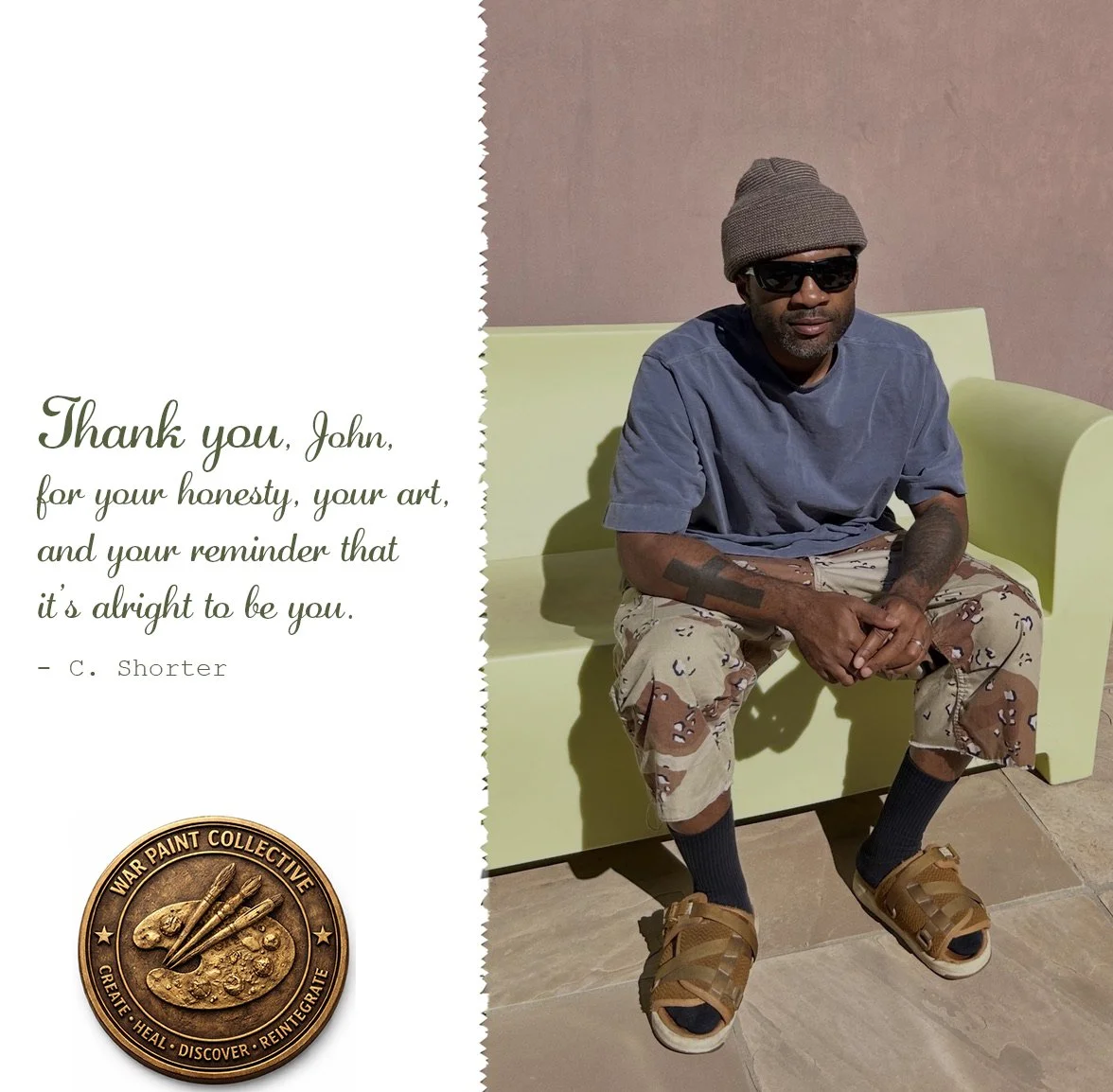
War Paint Collective sits down with Navy veteran, father of seven, and self-taught painter to talk about the identities he chooses, the one he can’t escape, and the gallery director who wouldn’t let him give his work away.
- Interview by C.Shorter
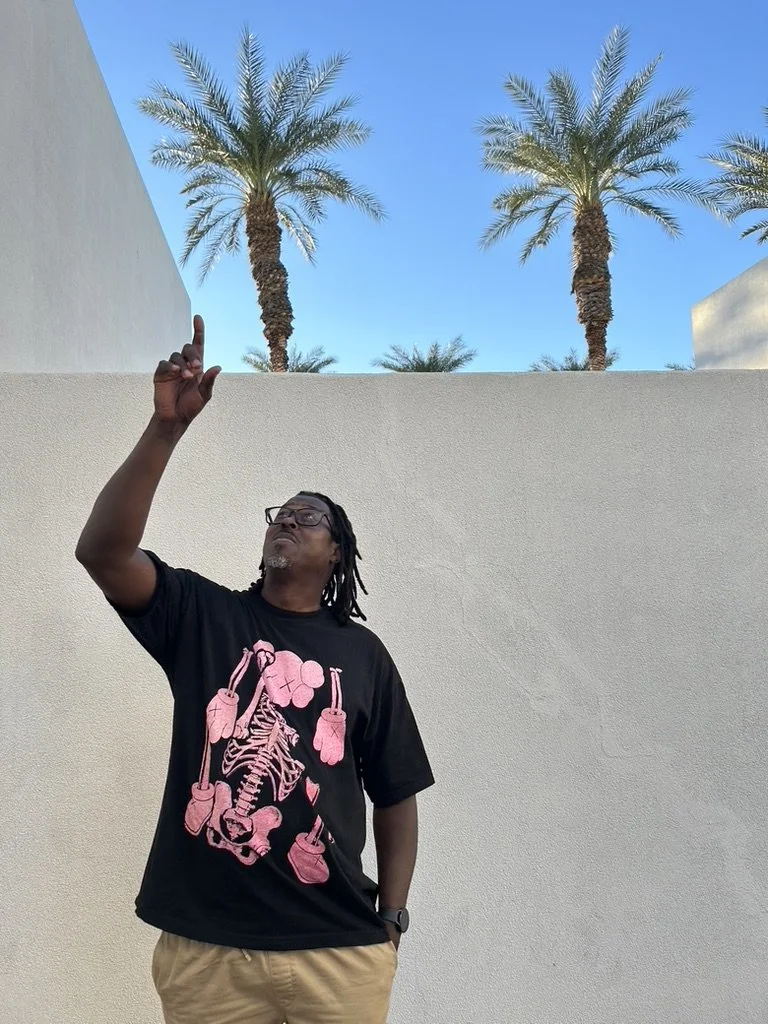
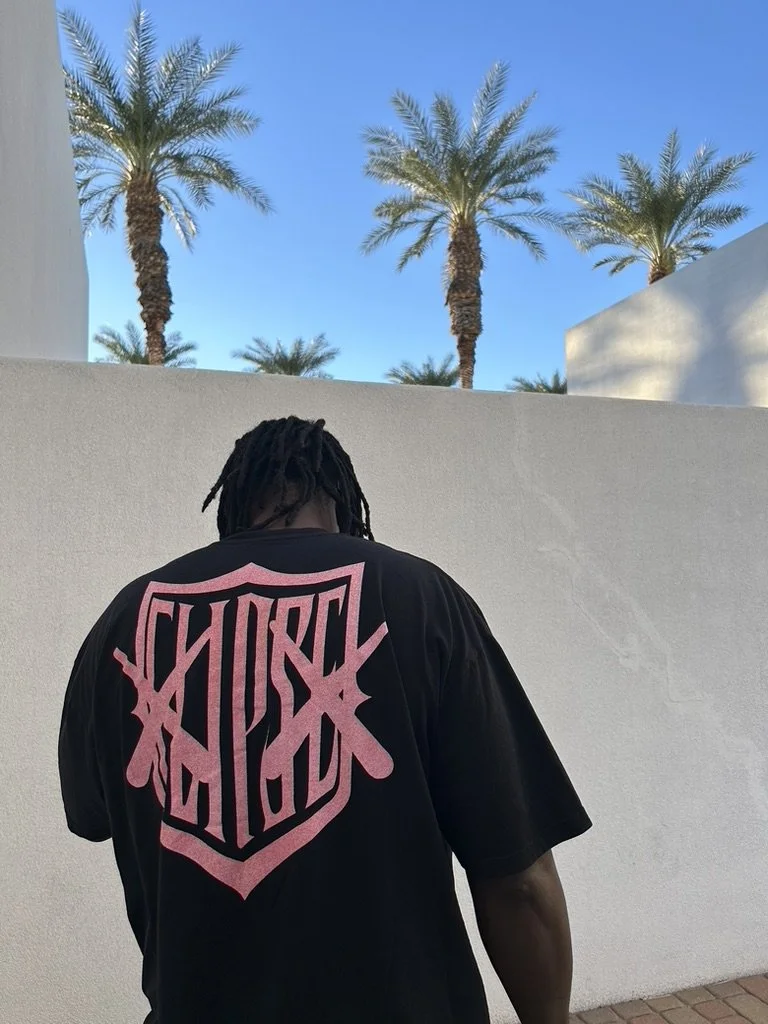
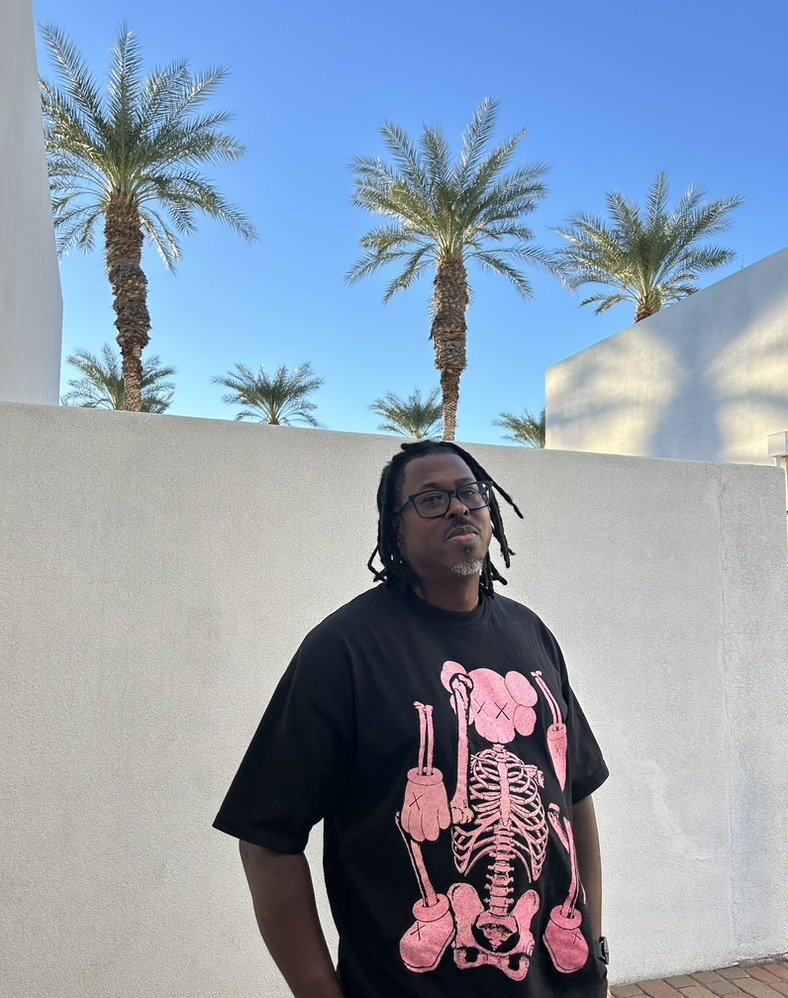
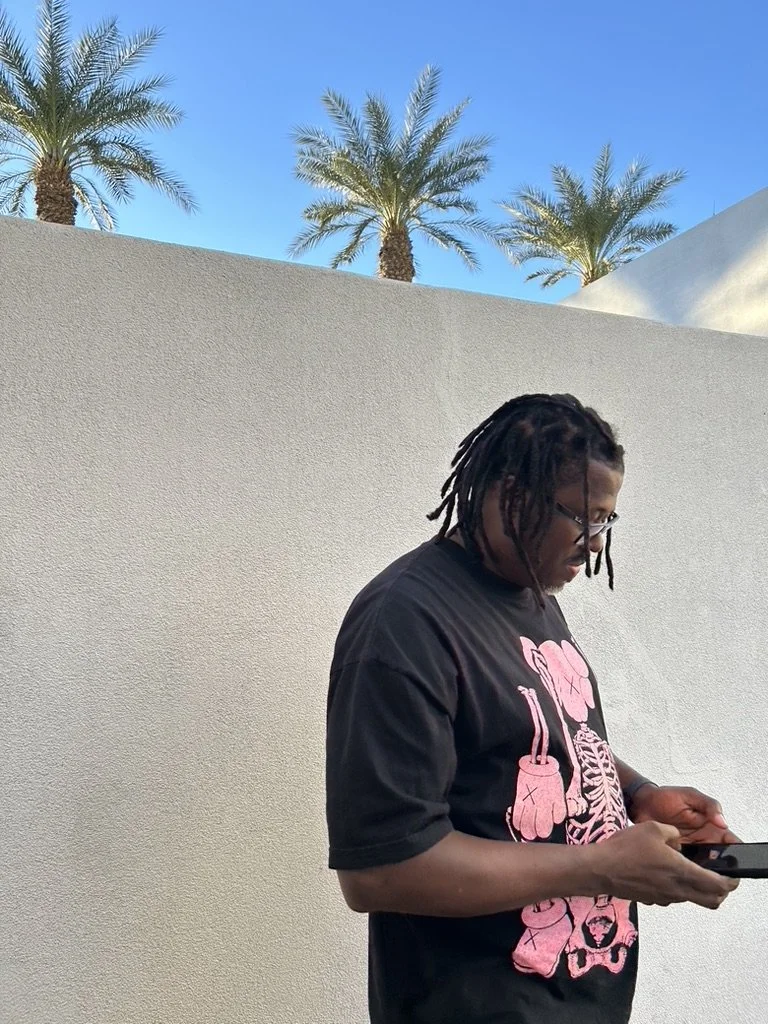
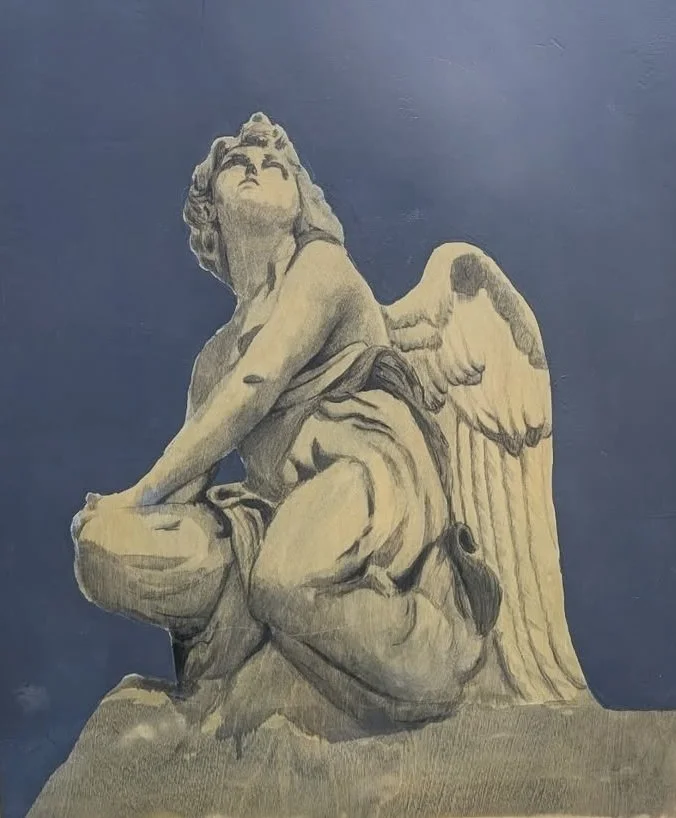
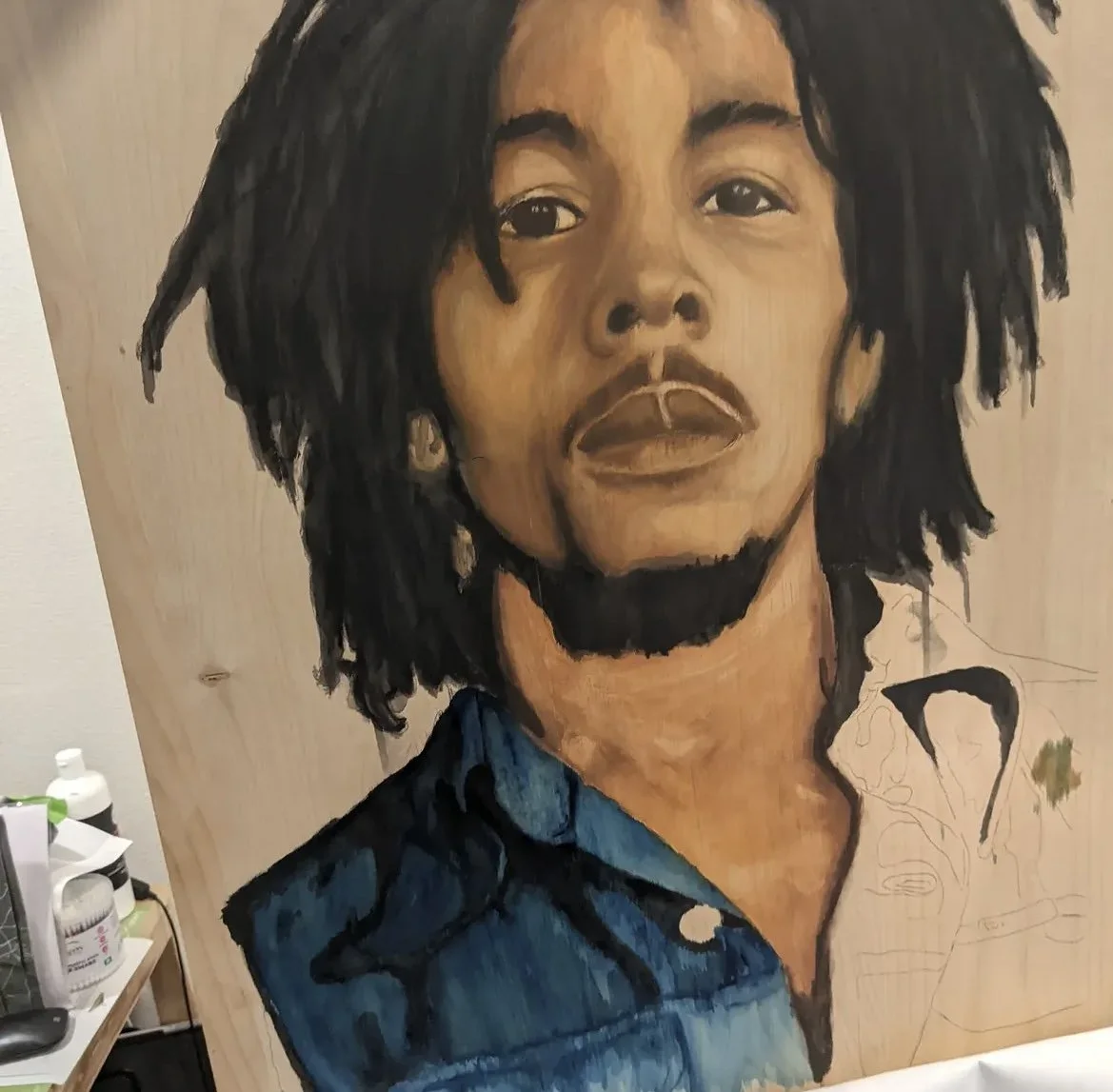
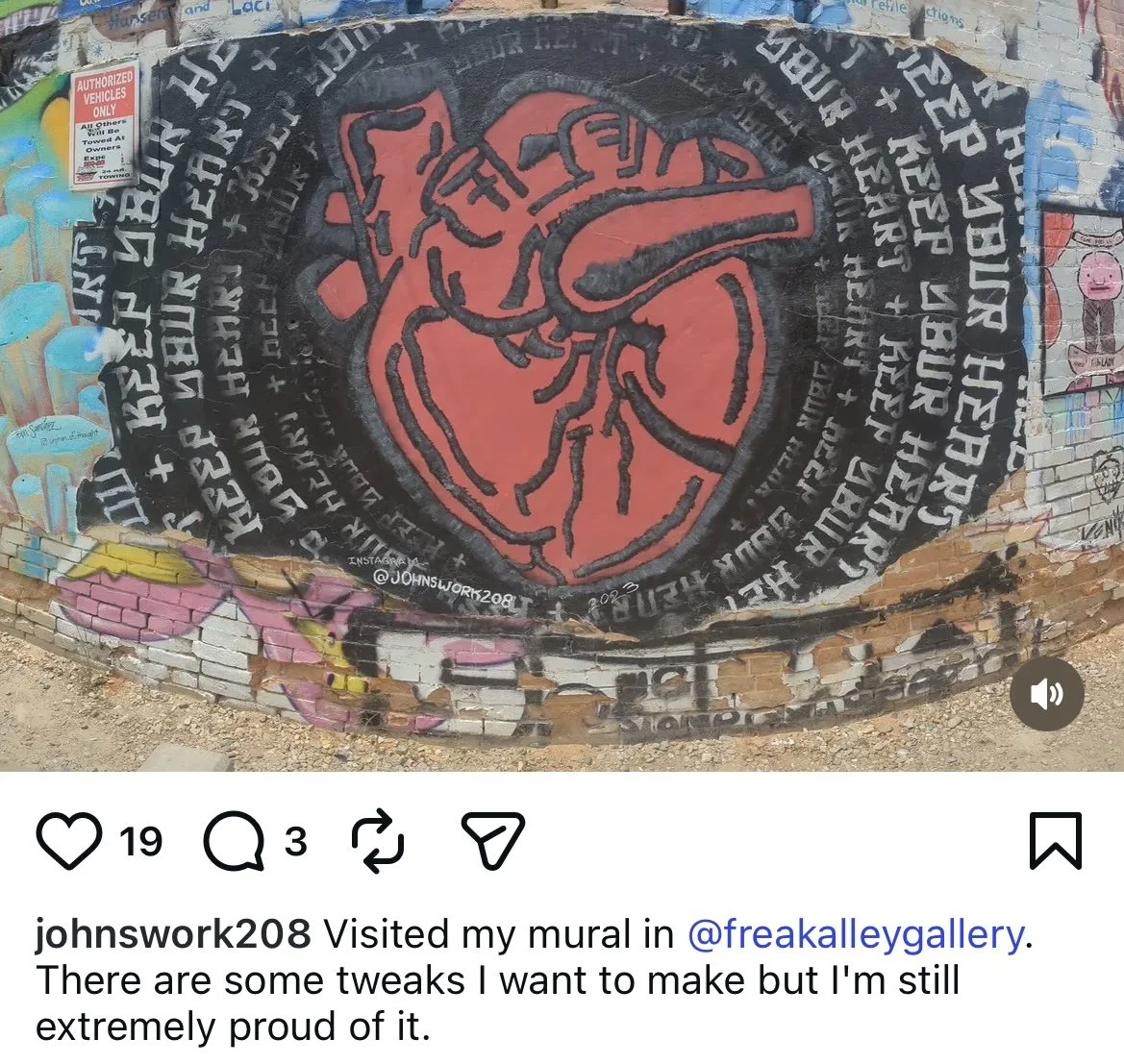
John Hargrett didn't call himself an artist for a long time. He made things because he had to—on wood panels in his garage, with stub pencils in a jail cell—and then threw most of them away. Today he works mainly in wood stain, coaxing the reds, browns, and blue-black undertones of Black skin out of bare panel. One of his pieces anchors a mural in Boise's Freak Alley. Another, a flat painted heart that looks like it could be lifted off the canvas.
In a long conversation with War Paint Collective, Hargrett, 45, talked about growing up as the much-younger sibling who never quite fit, the Navy career he was good at and bad at in equal measure, and why the opposite of fitting in is belonging.
I. THE MAN BEFORE THE ARTIST
Before we talk about the artwork: who is John Hargrett? How would you describe the man you've become to someone meeting you for the first time?
This is actually not that difficult a question, because what I've built myself on is this: I'm a collection of identities that I choose, and with those identities, of course, there comes a metric for being successful at each one.
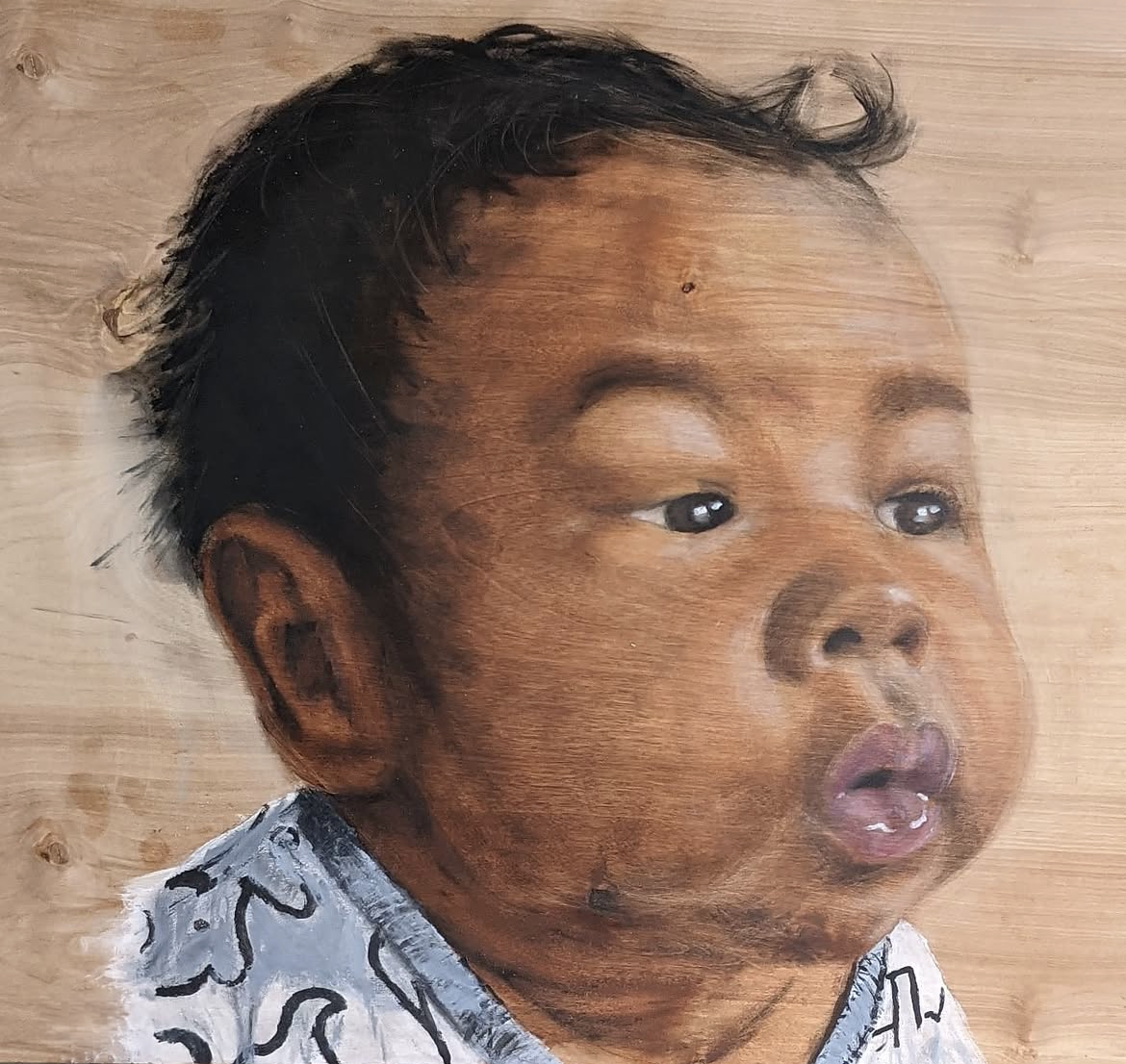
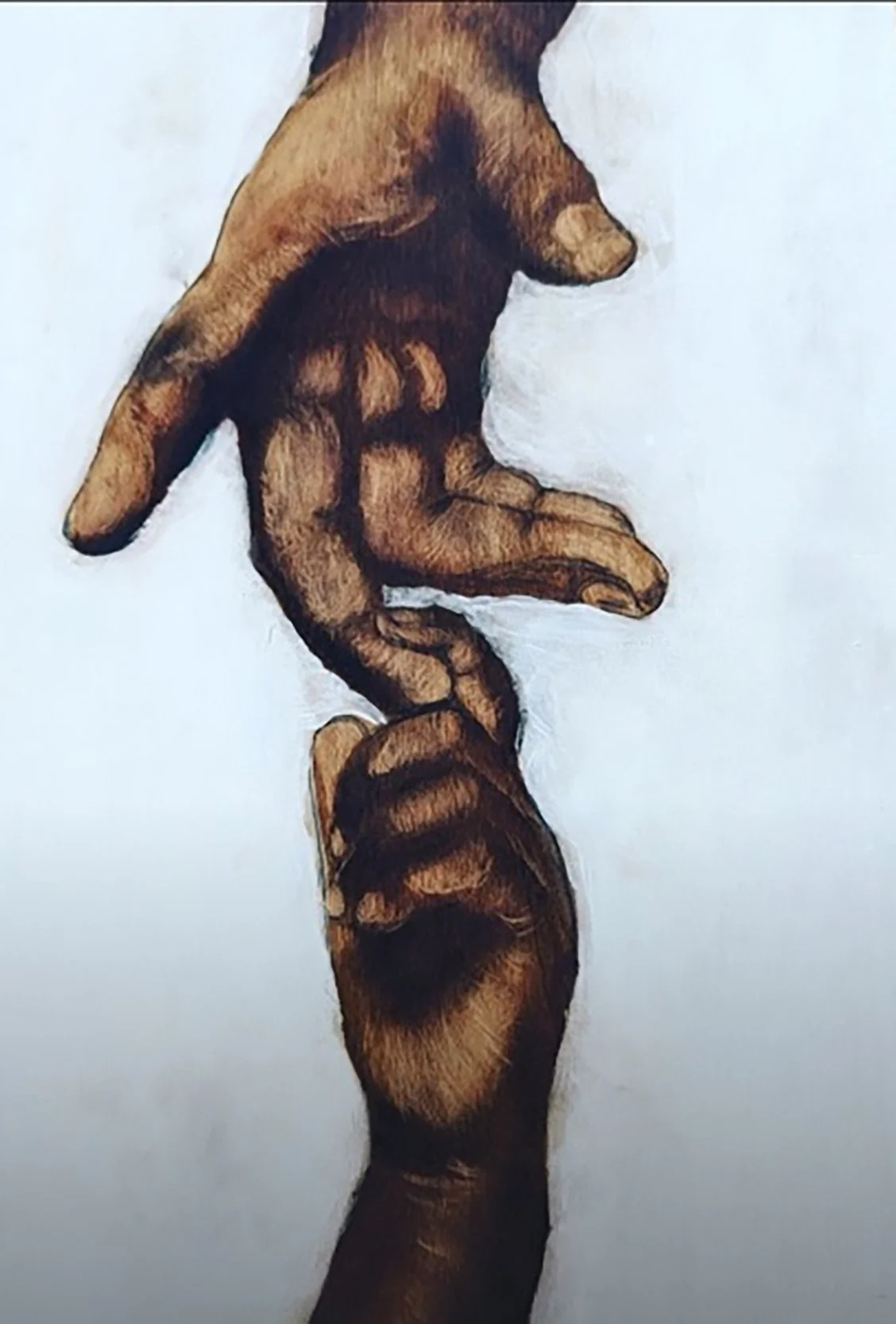
First and foremost, my most important role is father. Everything I do, in some form or fashion, is based off of what I want to do as the father of seven kids in various stages of development. That's my primary identity.
After that comes the identity of Black, or BIPOC, because America can't let me forget that I am Black. I can't ever be anything other than that. No matter how well I speak or anything, that will always be a part of me. The metric for being successful at that is: I am. That's just what it is. I don't have to do anything. There's no monolithic way of acting Black. I'm Black no matter what I do. So I embrace that, and I'm proud of that. I'm proud of where I came from, my lineage, and all the things the generation before me went through to allow me the freedom to be expressive and unique the way I can be today.
Think about the young man you were when you entered the military. What did you imagine your life would look like, and what were your expectations of yourself?
Part of how I grew up was not really being accepted anywhere, even within my own community. So I didn't really have expectations of my life. I existed, and I shaped myself to be whatever I needed to be in whatever situation I was in. Because I didn't know myself, I had no expectations of myself. I didn't build an identity outside of “How do I need to behave so I can be accepted in this group?” Never being authentic to myself, never building any type of self-acceptance independent of what other people felt around me.
I didn't do well enough in high school to get scholarships anywhere. So I went to the military: I'll make some money, I'll be an adult, and I'll figure it out as I go.
So your expectations were just to be who you needed to be to get through.
Yeah. That's all it is. There was really no sense of self. Absolutely none. I had a sense of self in that I knew me, but it wasn't something curated and directed. It wasn't something I shared with the world. I wasn't authentic to who I was. I love comic books—never talked about it. Love cartoons—never talked about it. I love disco music—never talked about it. Never shared it, because I didn't want to be judged or critiqued.
Which goes back to the first question: the thing you'll never be able to avoid is that you're Black. And the only thing you were doing was making sure you fit that bill while navigating this new world and doing what it expected of you. So you didn't feel there was space to be Black on your own terms—I'm Black no matter what I like, no matter what I enjoy, no matter how I talk. I'm still what I am.
Correct.
How did your military experience shape the person you became, both in ways you expected and ways you didn't?
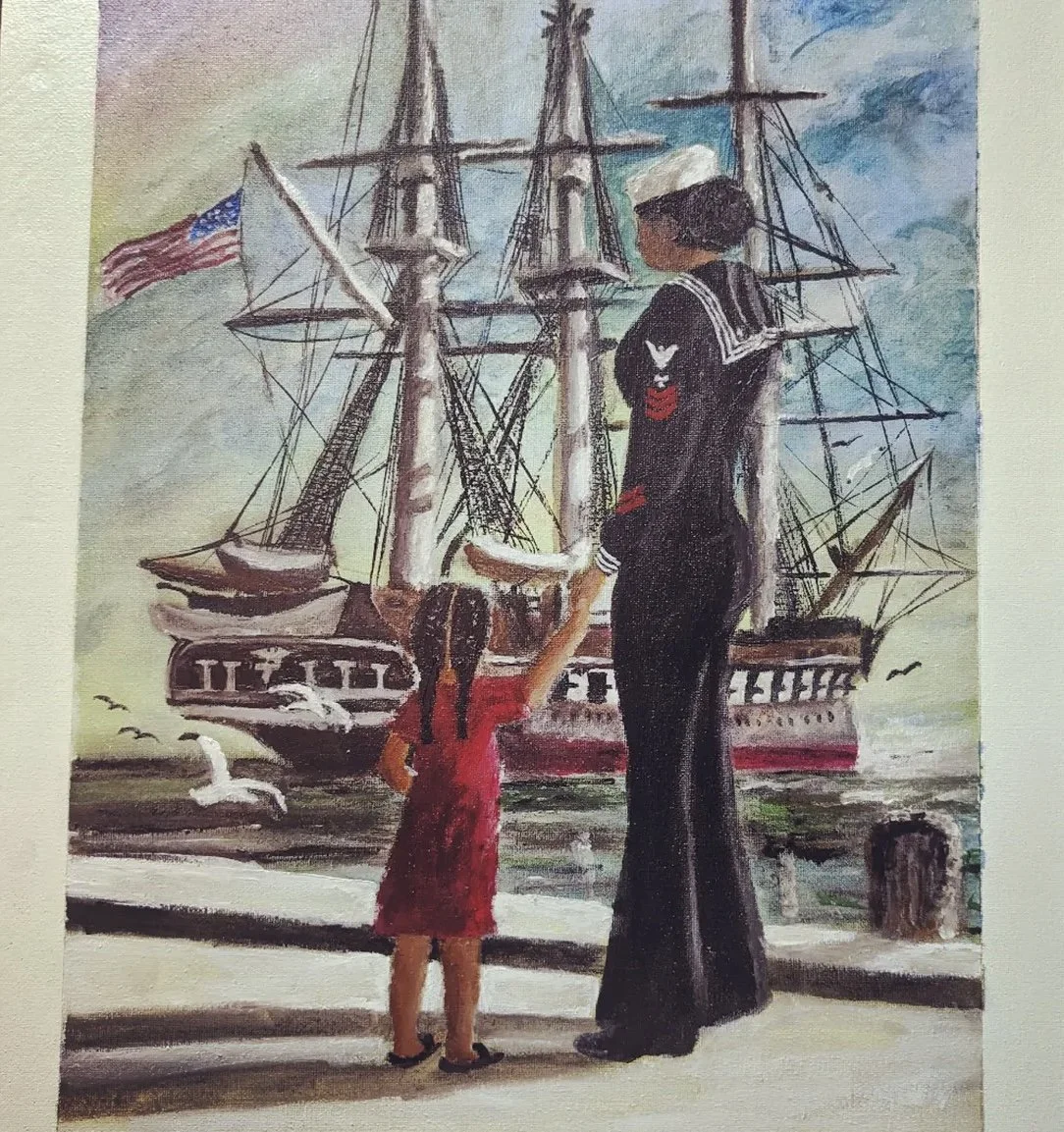
It opened me up to many different people and cultures. It showed me that there can be nuances in Blackness, nuances in every identity. It also instilled in me a certain structural approach to being functional, and that's one of the greatest things. I can honestly say that without my military service, I would not be as functional an adult as I am now. Because at the end of the day, when you're stuck on a ship, you find a way to make a way. You take what you have, you make what you need, and you stay functional.
II. UNEXPECTED TURNS
Let's talk about the unexpected turns that life can take. Did your military career go the way you wanted it to go?
Absolutely not. I was never good at the military. I was always good at my job in the military. I was a fantastic electrician on the ship. Every place I've been, I was sought after for achieving things. But I was terrible at the nuances of military life: military bearing, being on time, abiding by what at the time I felt were asinine rules. It took maturity to understand the reason for that is to create a standard of expectation that bleeds over into your work. I always felt, Well, look, I can do the work. I don't need to do all the extra stuff.
It put a little chip on your shoulder. It's a challenging job, and you can do it, so you give yourself a little more space to say, Well, I don't gotta do all that, because y'all need me right now.
It's not even that. It really didn't happen until I got on the ship and was actively working down in the engineering spaces. I come up out of the engineering space—I've been on watch for however many hours, then I'm doing maintenance items—I'm filthy, I'm hot. And the first thing somebody sees is, Those boots need to be shined. Forget these boots! What about these salt rings on my coveralls? I lost like four pounds of water weight in the last six hours, and you're worried about my boots?
So there's a level of resentment for what I felt was not being acknowledged for what I was truly accomplishing. I get it now, with a little maturity, but at the time it left me feeling resentful, and then rebellious. It turned into a slippery slope. Like, yeah, I'll do what you want, but every chance I get, I'm a full-on rebel. Oh, you want me to do all this? All right, cool. I'll find something along the edge, in the gray area, where I can get away with challenging authority.
After the military, did you ever find yourself questioning who you were without that part of your identity?
No. I was never one that adopted the military as a part of my identity. I was in the military; I was not a sailor in how I carried myself. It was part of my history. But long before I got out, I was already acting like a civilian while I was in the military. So there wasn't a big change. Outside of the uniform, I wasn't the best version of myself. I was making choices that didn't line up with the man I was supposed to be. All the stuff I shouldn't have been doing in the military, I was already doing. So not being in the military made no difference, because I was still doing the same thing.
So did your identity post-military connect with your identity pre-military?
Yes. I had more maturity and a broader skill set, but my identity before the military was very much ingrained in the life I knew growing up in Florida, and outside the military I leaned back into that old version of myself. There was familiarity in that. Eventually life happened, and there was a maturation process that really propelled me later on. But initially, getting out, it was like: Yeah, I was in the military, and now that I'm out, I'm just the same person I was when I went in—with a lot more skills and capabilities.
Let's talk about isolation. It shows up in a lot of different places, whether it's in the military, being separated from your daily norms post-military, or things happening in relationships with friends or significant others. What have those periods of isolation and loneliness taught you about yourself, about other people, and about the meaning of belonging?
Because of how I grew up—and well into my thirties, after the Navy—I never felt totally accepted. I'm functional; I can be accepted. But it's not like I was accepted. So in that sense, I've always been lonely. It was just something I lived with. That was the state of my being. Growing up, I had people around me, but it's hard to not be lonely when you can't talk about half the things you enjoy in your life.
You were different from a lot of the people you were around, no matter the situation.
I was different from the people I was around outside my home and in my home. I was never accepted anywhere. There was always a certain level of aloneness, and it came to a point where that's just what I expected: I'll never be accepted as a total person. I'll just find someone who accepts me enough.
Do you think that isolation helped you or held you back in terms of living as your authentic self?
Everything has a duality. The good I got from it: in those times of isolation, physical or mental, where I was feeling lonely or was by myself, I learned to be okay in solitude.
One of the things my pops told me early on, when I was talking about being bored—he said, “Boredom is a self-inflicted wound. You're only as bored as you allow yourself. If you can't sit still with your mind, that's your problem.” And that really helped me. Standing watch in the propulsion plant by myself, there's no outside stimuli. There's not a TV to distract me, there's not a book to read. There's nothing but tech manuals and the dials you have to watch. How can you maintain your interest in that moment? By being introspective, using your mind to create entertainment independent of outside stimuli. It allowed me to function in ways that most people couldn't with being alone. I found solace in solitude. I still enjoy it—just literally being by myself, sitting down somewhere.
You mentioned your father, and how different you were from everybody else. Are you the youngest of your siblings?
I'm the youngest by—let me see. My youngest sibling is seven years older than me, and my oldest brother just turned 70. I'm 45.
Twenty-five years. That's a lonely thing in itself.
Yeah.
Looking back at some of your most difficult chapters, was there something you needed—support, understanding, community—that you didn't know how to ask for at the time?
Understanding and community, for sure. I was in Idaho, so I was a super-minority there, going through a time where I felt like I was being misrepresented by the judicial system. I didn't feel like I would get the benefit of any doubt. I felt betrayed by society. I felt betrayed by the person I was in a relationship with. And I couldn't identify a person or group of people I could just be okay with, who could allow me to be vulnerable. So I shelled up. I became harder.
The vulnerability of needing anyone was something I couldn't afford at the time. And not because I didn't want it. Even to this day, to a certain extent, I'm always on guard everywhere I go. I may forget about it when I'm at home, and then something will come up with my wife and I shell back up, because—wait a minute—I've allowed myself to be vulnerable. To be hurt, to be betrayed, to not be prepared for something to happen. That's what it is: staying constantly prepared to react to a catastrophe somebody else is making.
III. DISCOVERY
Discovery has always been a part of your life, even during difficult times. When did you realize that being an artist wasn't simply something you enjoyed, but something you needed to pursue?
I would get desires to make something, and it'd be like a nagging itch—a borderline compulsion. I have to do it. I need to create something. I get an idea—Oh, I wonder how that would look—and it wouldn't be until I did it that the compulsion would be satiated. And I didn't feel comfortable showing it to anybody. I would just make stuff to make stuff and then put it away. There are so many things I made just because I was compelled to, that I would just throw away. It needed to be created. It didn't need to be kept.
One of my hardest times was being locked up. It's this very regimented thing. We talked about being on high alert—in there, I'm on extra-high alert because of the atmosphere. I'm carrying a huge boulder on my shoulder, ready to pop off at any minute. To maintain my own sanity, I needed to have that focus and create. Little crappy jail pens, a tiny pencil—just trying to make something. It was to stave off the depression of where I was, how I'd gotten there.
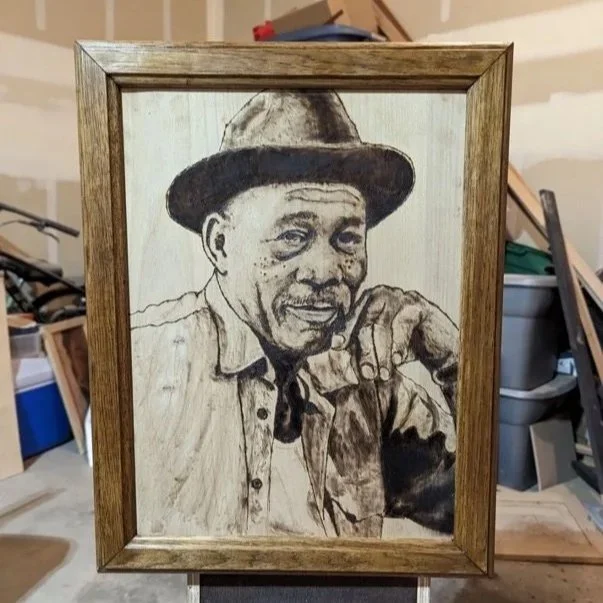
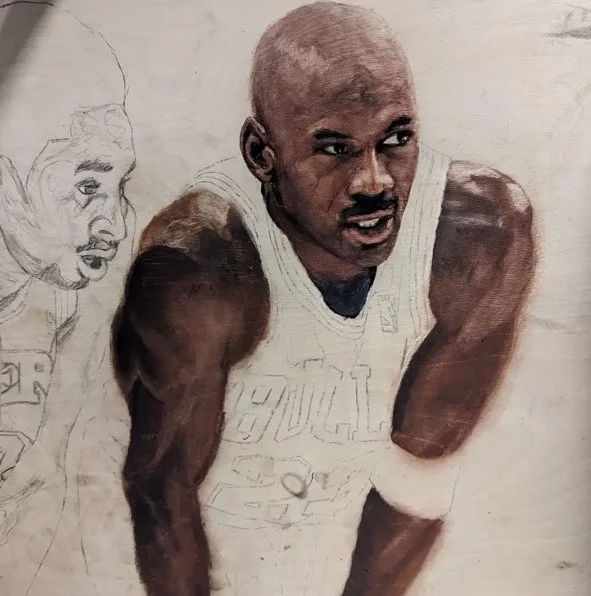
It wasn't until after I got out that I came across an art collective. It was through the encouragement of some of the members, particularly the director, that I got pushed: “You can be an artist.”, Because I never felt like an artist.
I'm just a dude who can draw and paint. I didn't identify as an artist. I didn't feel authentic as an artist. It's just something I could do. Even now—when I started thinking, Okay, I need to sell art, I felt like I lost part of myself. I started to equate selling my art with being an artist. I need to make art that people will like, that will sell, so I can be an artist. It had nothing to do with what I wanted to create. It wasn't until I got out of that mentality and just focused on creating things that I started to feel more like an actual artist, and found more meaning in what I was creating.
The art collective—was it called Catalyst? How did you find that community?
I was actually coming out of therapy. The art collective used to be half a block from where I was going to therapy, and I had never looked over there. Then one day I saw a sign that said Catalyst Arts Collective. So I just walked over there, leaving therapy feeling a little bit better about things, as you should, and talked to somebody. They told me, This is a space where different local artists come to display pieces and sell pieces, and there are classes—all these great things. I just felt like, “I wanna be a part of that”.
I didn't meet the director then, but I scheduled an appointment with her for another day. I brought some of the pieces I'd just been making and throwing in the garage—because, again, I was making it just to make it. I had an idea, so I had to make something.
She was actually the first person to buy a piece of artwork from me. And I was like, Yeah, I guess you can buy it—you can have it. But that was a pivotal moment, because she told me, “You cannot give your artwork away. You're cheapening yourself, and you're not doing a service to anybody. I won't let you give your artwork away.”
She went on to help me later with pricing, the first time I was going to be a vendor at an event and have a booth. She came to my house, and as I pulled out pieces, we came up with a pricing strategy and priced all the pieces there. She'd ask me, “So what do you think for this?” And I'd say, Oh, yeah, that's sixty bucks. And she'd say, “Nope. Now times two, plus five. That's a hundred twenty-five, a hundred thirty.” It went on like that. Coming up with those plans for how I'm gonna price everything really made me feel more legitimate.
She saw things in you that you didn't see in yourself.
Absolutely.
When's the first time you drew, painted, or put something together and felt like, That's art? Was it in your younger years, or when you got older?
First I've got to define what art is. Some of my drawings and stuff like that—that's what I would call soft art.
You get to define what art is to you.
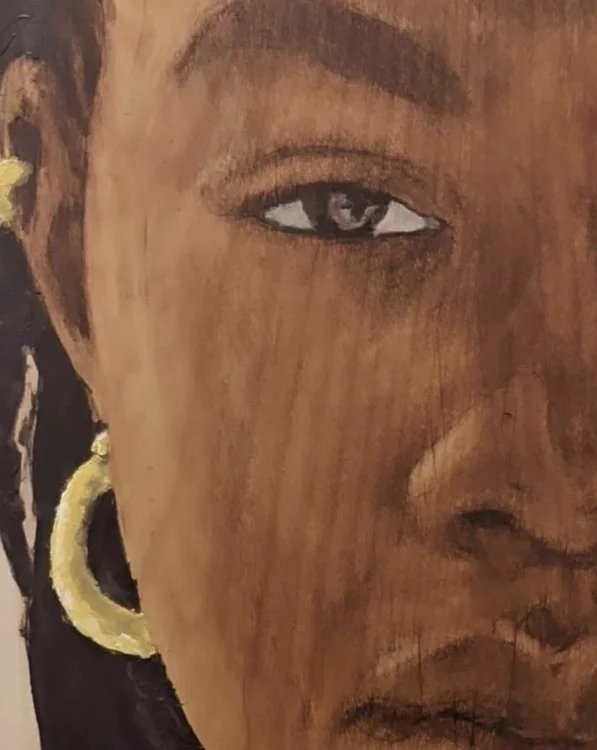
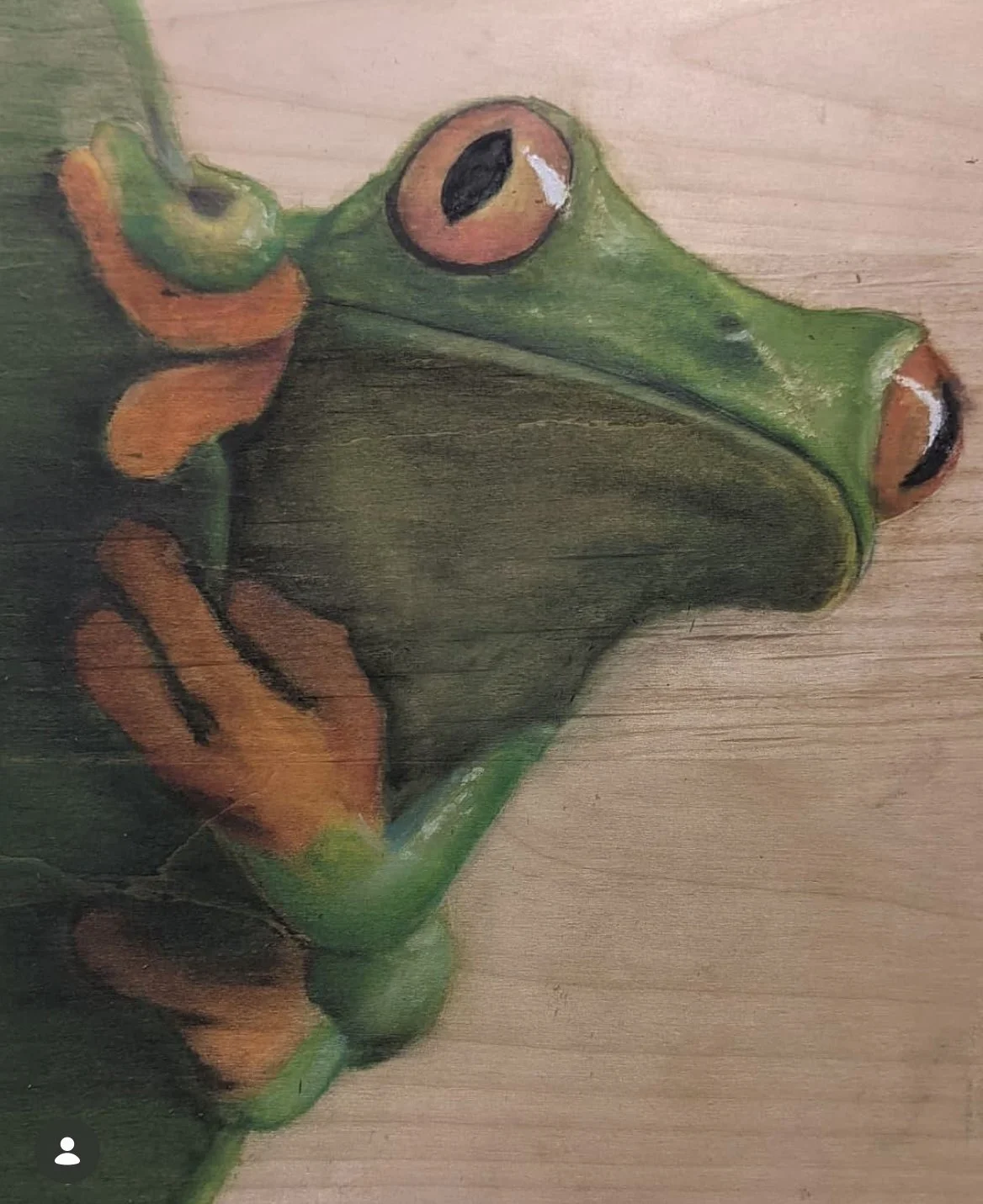
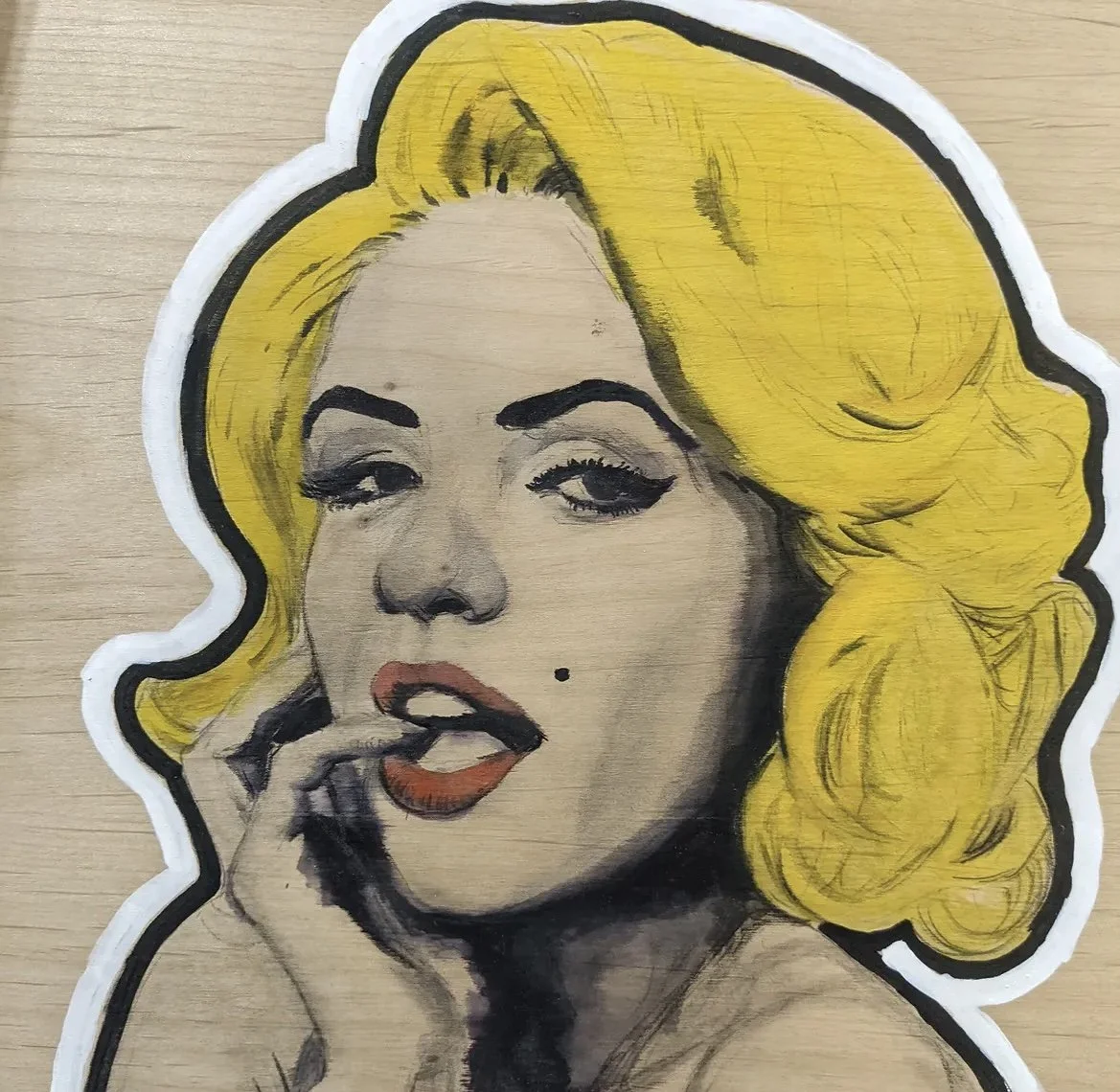
For me, it was one of the pieces I made, the first time I tried it. I had a bunch of wood paneling, and I was wondering if I could use wood stain to make an image on a wood panel. My nephew Donovan is a photographer, and I saw one of his posts—a picture of a girl holding an earring. It was such a contemplative look. Man, I love that. I wonder if I can capture that. So I used it as a reference image. And I felt so good about how that looked. I can actually tell you exactly when it was, because of the time stamp on the picture. I did it in one night.
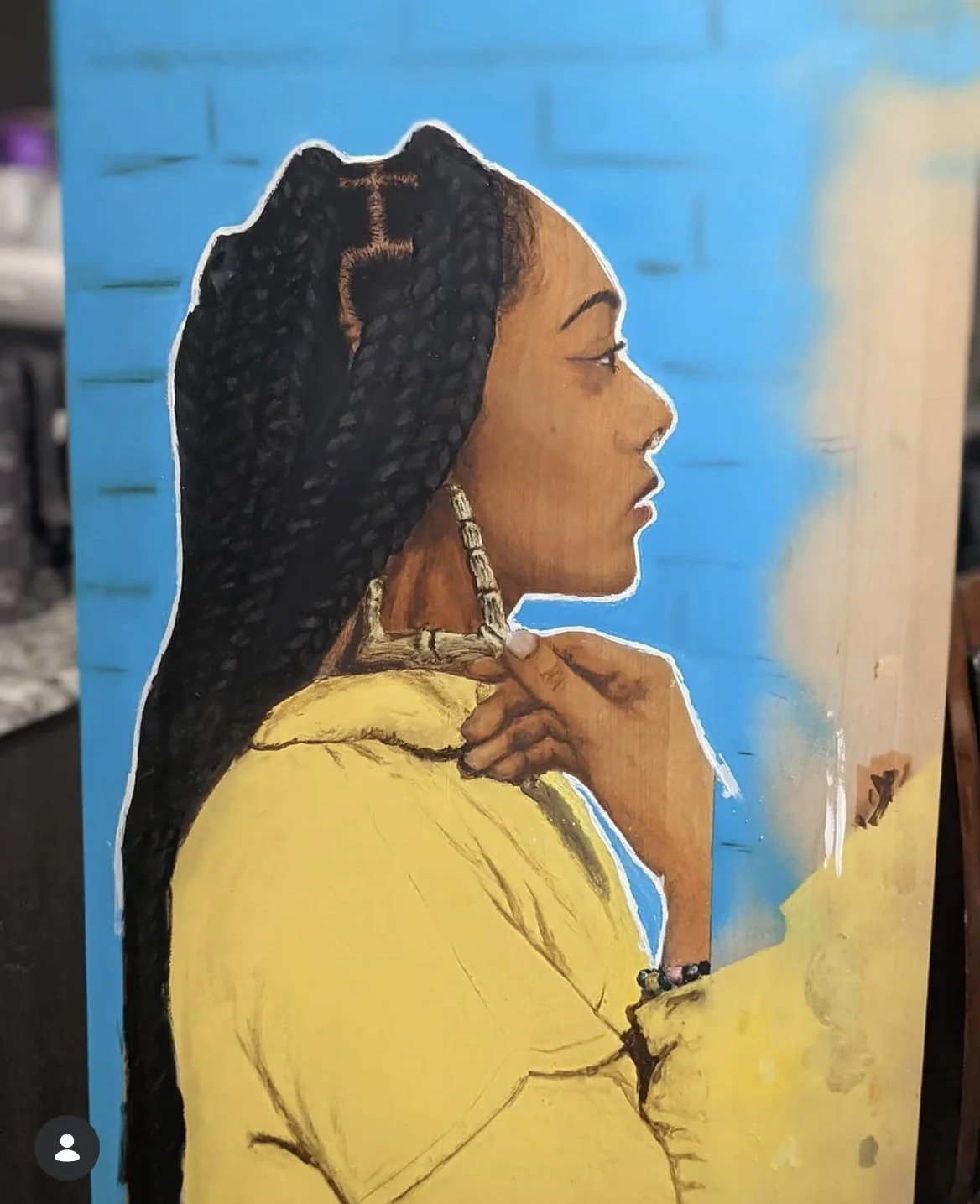
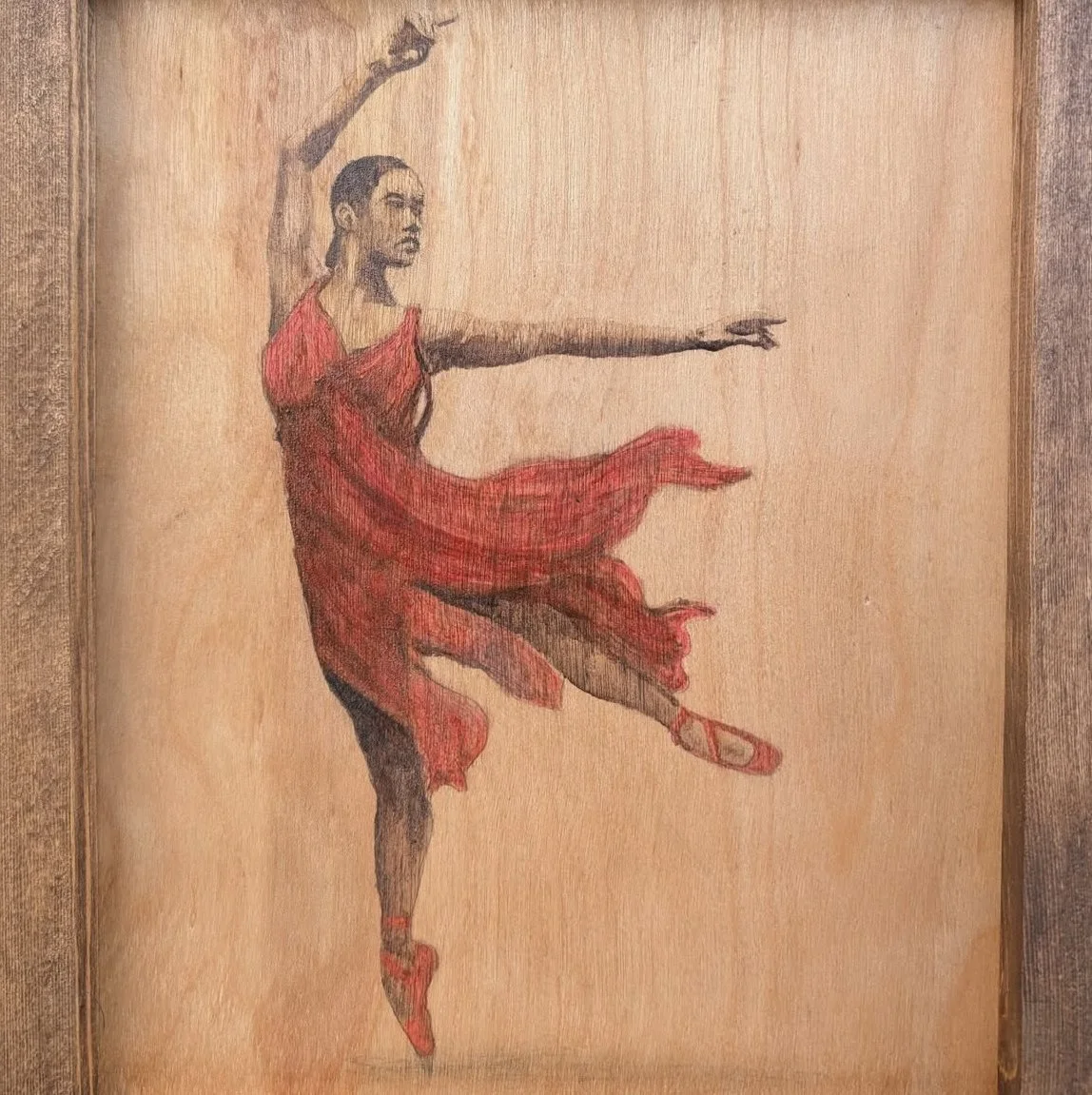
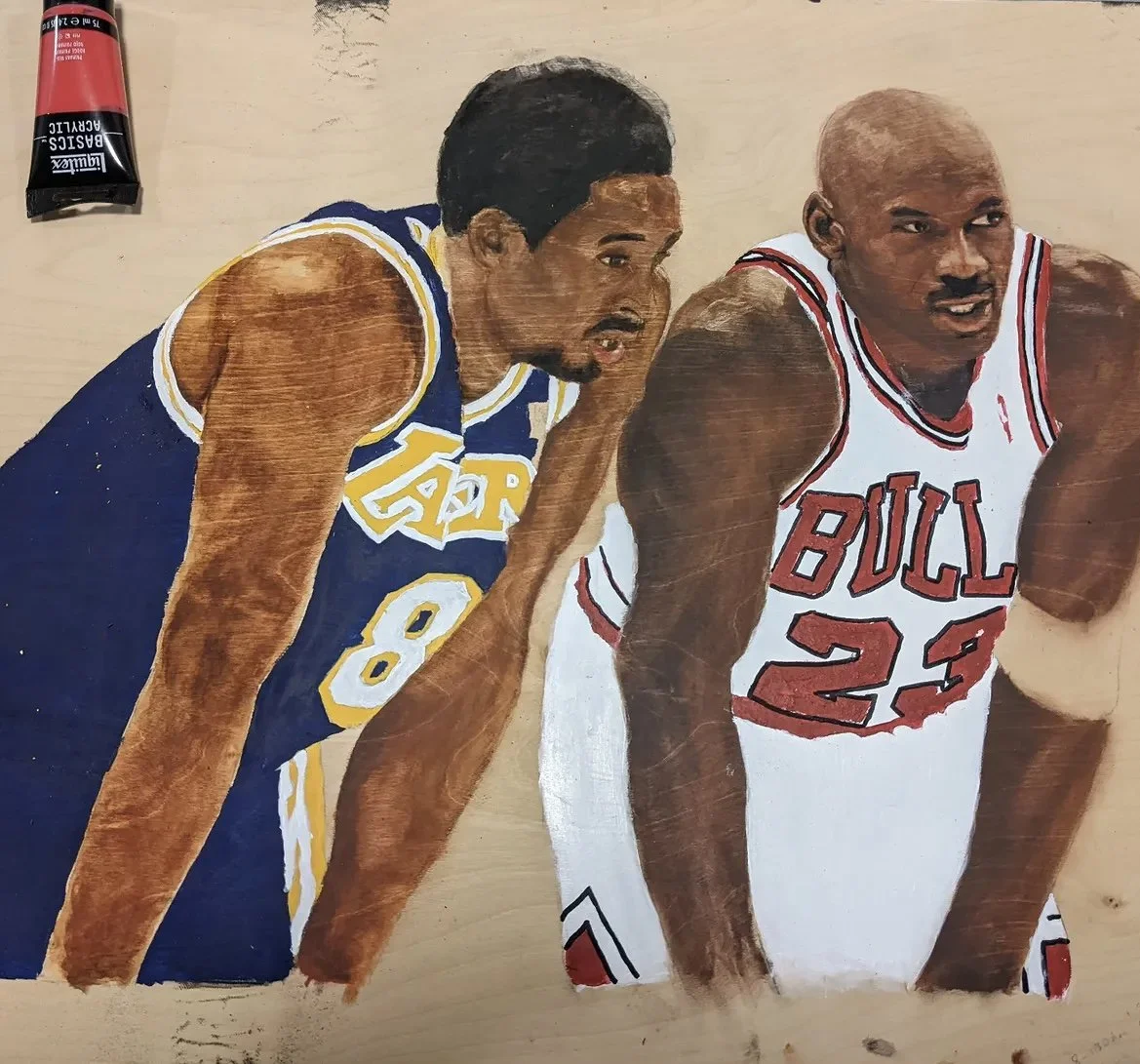
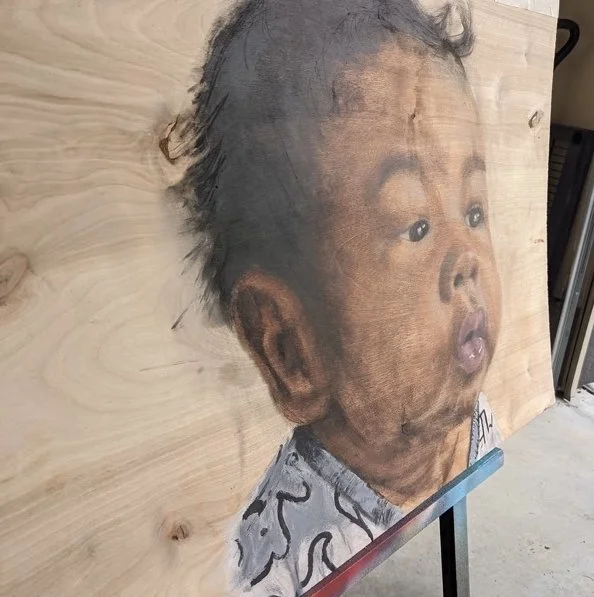
That was your first time using wood stain? Does it behave like watercolor?
Somewhat.
What'd you use for the hair?
Acrylic. The stain works really well on brown skin, and that was one of the things I really fell in love with—that I could do Black art with it.
Has creating art, specifically like this, revealed something about yourself that you never fully understood or couldn't put into words?
Yeah. I paint what I like to see. I paint what I think is beautiful. And I love Black people. I love brown skin. I love the hues and the different undertones—a sub-Saharan African with a richer, darker, bluish undertone to their skin, or, due to ethnic mixing, a lighter-skinned African American with reddish hues in their tones. Using the wood stains, coaxing those tones and hues out and shaping them—I love that. I love the looks of people. There are certain things that attract me, and I really, really like that. And it made me appreciate brown skin more.
So it gave you another level of appreciation for your own skin. Painting people who look like you—we could say that was a self-discovery process.
Mm-hmm. Yeah.
Walk me through your creative process. Do you feel like you have a signature style, and what do you experience when you're completely immersed in creating something?
My creative process relies on my musings, collected throughout my day and life. I have reference folders—an expanded Google Drive just full of reference images that eventually I want to do something with. Sometimes it's not even the whole image, just part of it. I have a huge Pinterest collection of different techniques I want to incorporate. Rarely do I want to do a direct replication of whatever I see. It's an interpretive replication with modifications—pulling from this, pulling from that, using different mediums, different tools, different techniques, different canvases, whether it's wood, canvas, or something I made.
Another part of my creative process is exploring different media. I wonder how crayon will work on clothing. Will it last? And of course you get inspiration from stuff—like seeing a guy who modified a tattoo gun to take a ballpoint pen and then started using that to do stippling. Man, that's dope. So it's always looking at cross-categorical thinking. How can this be used in that? Using tools that would normally not be used in this way to create X.
So contrast or exploration—one or the other, or both—is what you look for in your creative process. The concept might not be complex, but the process is: I want to use this tool, this material, this type of paint. Or I might want to go use some charcoal from the barbecue grill.
Yeah. It's also in my nature. I have a passion for learning. If I see something, I want to learn how to do that. And once I learn how to do that, I want to learn how to be good at that—not like a professional, but good at using that medium. Playing with watercolor: Okay, I know how to use watercolor—how can I be better at it? And then once I kind of master that, I start finding the similarities between two things. Oh, well, if wax acts like this on fabric, then maybe it'll act like this on something else. Or the slickness of a wood panel that's been finely sanded doesn't have the same tooth as a canvas, so maybe I could do a smear of paint that glides further, because it's not going to have the same grip. That's where the exploration comes in—understanding how the characteristics of these things work as you apply them.
And when I'm looking at pictures, it's like: What in that picture stands out? What is it saying to me? Oftentimes it's emotions, feelings I get in that moment. Other times it's something I can identify with, and I can feel the nostalgia in it—a past memory. Sometimes that's just where meaning is for me.
It's interesting that you walked out of therapy and noticed this creative community that was always there—you just noticed it on that particular day, and you actually went over and took action. Do you agree that art can be used as therapy?
Absolutely. I absolutely agree art can be used as therapy. What I do not agree with—you've got therapeutic arts, and then you've got art therapy. I do not agree with how art therapy requires certifications to justify it, because it takes away the nuance. It can be a creative outlet. If I look at how I create art and how therapeutic it is for me, it wouldn't meet the criteria for art therapy.
A lot of the art therapy stuff is very guided. So, just to be clear, I'm asking about art as your form of therapy.
Oh, absolutely. It has helped me through the most challenging times in my life. It's not therapy in the sense of what that means for credentials, but I know it was therapeutic to me, in the process of creating. I felt it whenever I was going through challenges. And even when I'm not, it's still that form of therapy I look for all the time.
Outside of your wood-stain pieces, what's your favorite piece that you've created—or the most popular?
It's a heart that looks like it's crocheted, and it's all paint and markers. It's an illusory piece—completely flat, but it looks like it has so much depth. The name of it is My Heart. I refused to sell it, until I had a conversation with somebody. It is now listed for two million dollars.
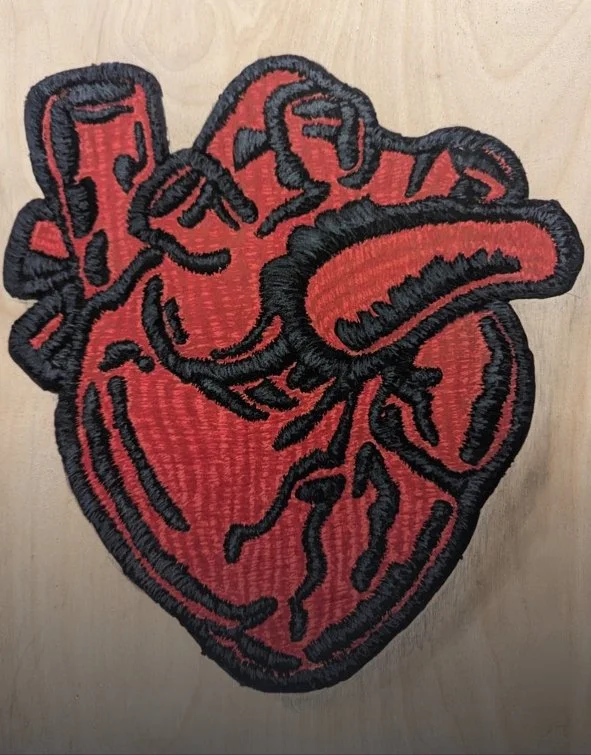
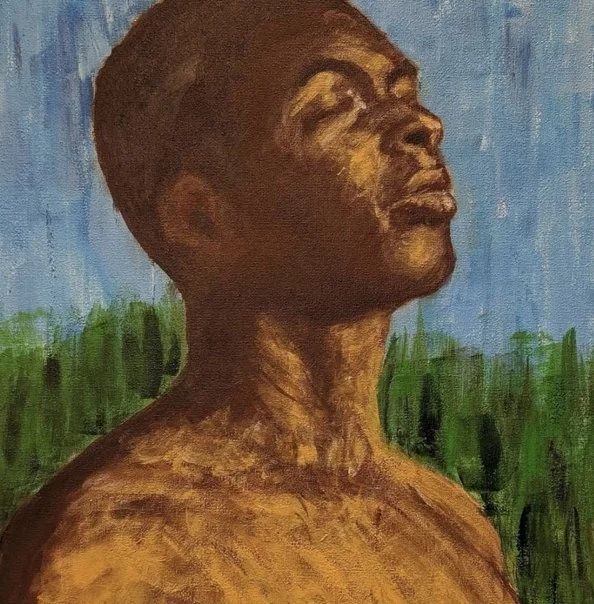
Because you can have my heart—but in buying that, you are buying the future for myself and my kids. Paying off a house. Ensuring we will always have a place to be. Solidifying a future, taking doubt away, putting me in a position where I could reasonably entertain stepping away from the workforce to truly commit to being a parent and an artist. You would have my heart if that sold.
If you made more paintings like that, would you price them all at $2 million?
No.
Could that technique, and that story, become a series—a handful of pieces you develop in that style?
I don't know. It's such a one-off piece. I've never done another one. I played around—I did one on wood for a guy I met while I was vending. He was a cool dude; he owned a printing and embroidery shop, and I did his logo in that style. It didn't come out the same. I didn't have the same connection to it that I had for My Heart. If I did more, it would just be to do that style. But that, literally—that's my heart.
Even with the idea of selling it—yeah, I say two million, but it wouldn't be an easy sell. I would do it, because it's function over feelings. But it has more value than that. Even at two million, it would still be a hard sell. Even thinking about selling it now, I'm like, Oh, man. I have a real heavy connection to that piece. And everybody likes it.
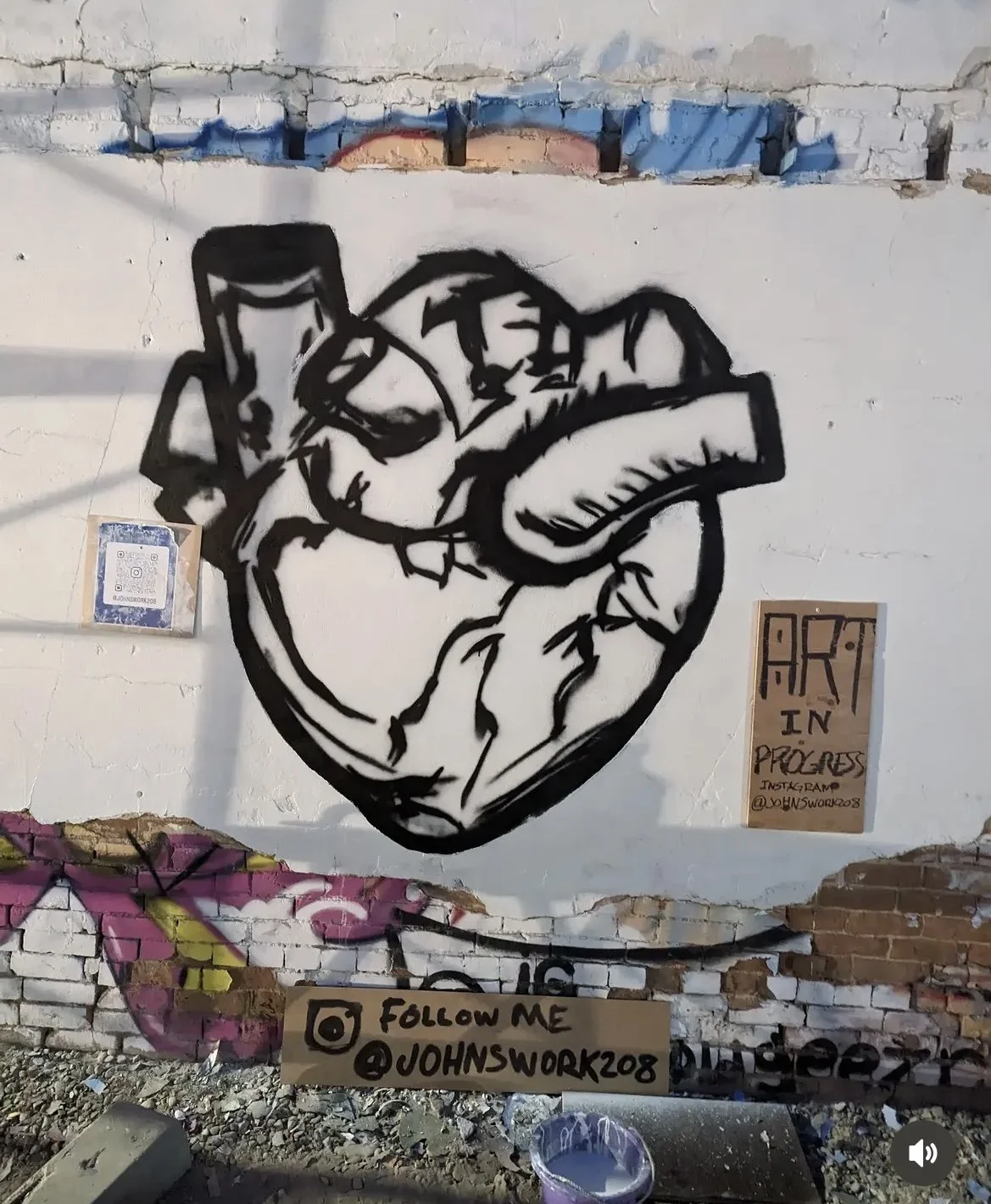
I used it as a basis for a mural I have in Boise. They have an outdoor mural gallery called Freak Alley. It started with the back door of a restaurant—this guy would let graffiti artists paint. Then it spread to the entire alley behind the restaurant and into the parking lot, and it became an attraction for people to come. It became curated spaces—not just people getting up and throwing stuff, but curated murals. It became an attraction for the city. So it's kind of a prestigious thing, because of where it is.
IV. COMMUNITY
We already went over Catalyst, and the director who helped you find your way in the art world—who showed you, nah, you're an artist, you're not just out here messing around. Since then, you've had opportunities to share your experience and support other artists. What has that taught you about the importance of creative communities, mentorship, and giving someone a chance to discover their potential?
Most people don't realize, when they start doing it, that the fear is always the first step. That's always where it is. I'm scared to start the thing because of the what-ifs, the what-ifs, the what-ifs. So for me, it's emboldening people: Yo, go be bad at it until you get good. Don't wait until you're good at it to do it for real. Do it for real and suck at it, then learn how to be better at it. It's that first step that teaches you, Okay, this is how it needs to be. This is how I need to be. You learn those lessons from one step to the next. That's the first thing.
And then just encouraging, because most people are self-deprecating. They don't believe that people wanna buy their stuff. So it's about creating avenues to show, in an objective way, how value can be added to what they're doing.
V. PURPOSE, EXPERIENCE, AND IMPACT
Knowing what you know today, what would you say to a veteran whose military experience didn't end the way they hoped, and who is struggling to figure out what comes next?
I think the biggest barrier is separating their military experience and their military identity—what they were in the military—from who they are as people. A big part of being in the military is: you were your rate. You were an electrician, you were a machinist's mate, you were whatever. That was something you did. That was not who you are. So if I'm speaking to a veteran coming out: You are who you are. You are the person you are, not what you did the entire time you were in the military.
For somebody like you, who had a bunch of older siblings and older parents, I'd say that would be a little easier to do than for someone who didn't know themselves at all when they joined the military.
I didn't know myself at all, either. Like I said, I didn't form a sense of self, because I was always a chameleon, adapting to be likable in different situations. I was never accepting of who I am as a person. But like I said before about the identities: Choose your identities, make the metric to be successful at that identity, and then live by that. Don't let everything else drive you.
Do you think having access to a welcoming creative community earlier in your journey, whether it was in the military or after, would have made a difference? What do you think those kinds of spaces can offer veterans and military families?
In my scenario, I don't know if it would have made a difference when I first came out, because I reverted back to how I was before I got out. But I could see how it could help somebody just getting out be more collaborative and build better versions of themselves with that support. Even though I came in at 17, I was a little different, like you said, because I had older parents. But if I had been somebody else who came in at 17 without all of that, having that support would have been beneficial.
There's a saying I came across a couple years ago—I can't remember who it was—that the opposite of fitting in is belonging. [The idea is Brené Brown's.—Ed.] Because fitting in means reshaping yourself to be in a place. Belonging means you are in a place that accepts you as the shape you are. So providing spaces like that, to create and foster a better sense of belonging, is definitely valuable for people coming out of the military.
If you could create an artistic experience for someone who's feeling isolated, disconnected, or uncertain about their future, what would you want that person to walk away with?
I want them to feel like they can—that they're capable. And that it's okay to not be perfect. It's okay to not be successful at first.
VI. FOR THE YOUNGER SELF
If you could sit across from the young man you were when you first joined the military, knowing everything you've experienced since, what would you tell him about the life ahead of him?
It's all right to be you. It's all right to be you. And don't trade the long-term goals and wants for immediate pleasure. Be who you are. Accept that you have a direction, you have a plan, and make sure you are doing everything to drive that plan to completion.
When everything is said and done, what do you want people to remember about John Hargrett—not just the artist, but the man?
He did the best he could. That's it. That's really all I do. I do the best I can.
That's a great way to look at it.
Yeah, as Art Williams put it, “all you can do is all you can do, and all you can do is enough.”
I do my best. I don't leave nothing on the board. I would love different outcomes, but all I can physically control is what I physically do. And I'm doing the best I can. That's all I can do, and that's good enough.
Last question. There's somebody, somewhere, reading this conversation who feels disconnected, who's questioning their purpose, or who believes the most meaningful part of their life is behind them. If you could speak directly to that person, what would you want them to know?
There's someone in the world who will accept you for who you are. So don't give up being who you are. Don't stop being who you are because the people around you right now don't accept it. Be who you are. You will find your people. You will find your tribe. You will find your family—the one you choose, the one that accepts you for who you are.
John, Thank you for sharing your story with us.
Follow John Hargrett’s work
Be the first to discover John’s latest artwork, upcoming exhibitions, and special events. Follow him on Instagram @Johnswork208 to stay connected with his creative journey and find out where you can experience his work next.
** Get involved with War Paint Collective **
Be part of the story. War Paint Collective is a community of veterans, service members, and the families who stand beside them, finding their voice through art. There's a place for you here.
Follow us on Instagram and Facebook for new stories, events, and artist features.
Volunteer your time, skills, or creativity to help veterans find their community.
Get involved as a military family member. Spouses, children, parents and caregivers serve too, and your story belongs here.